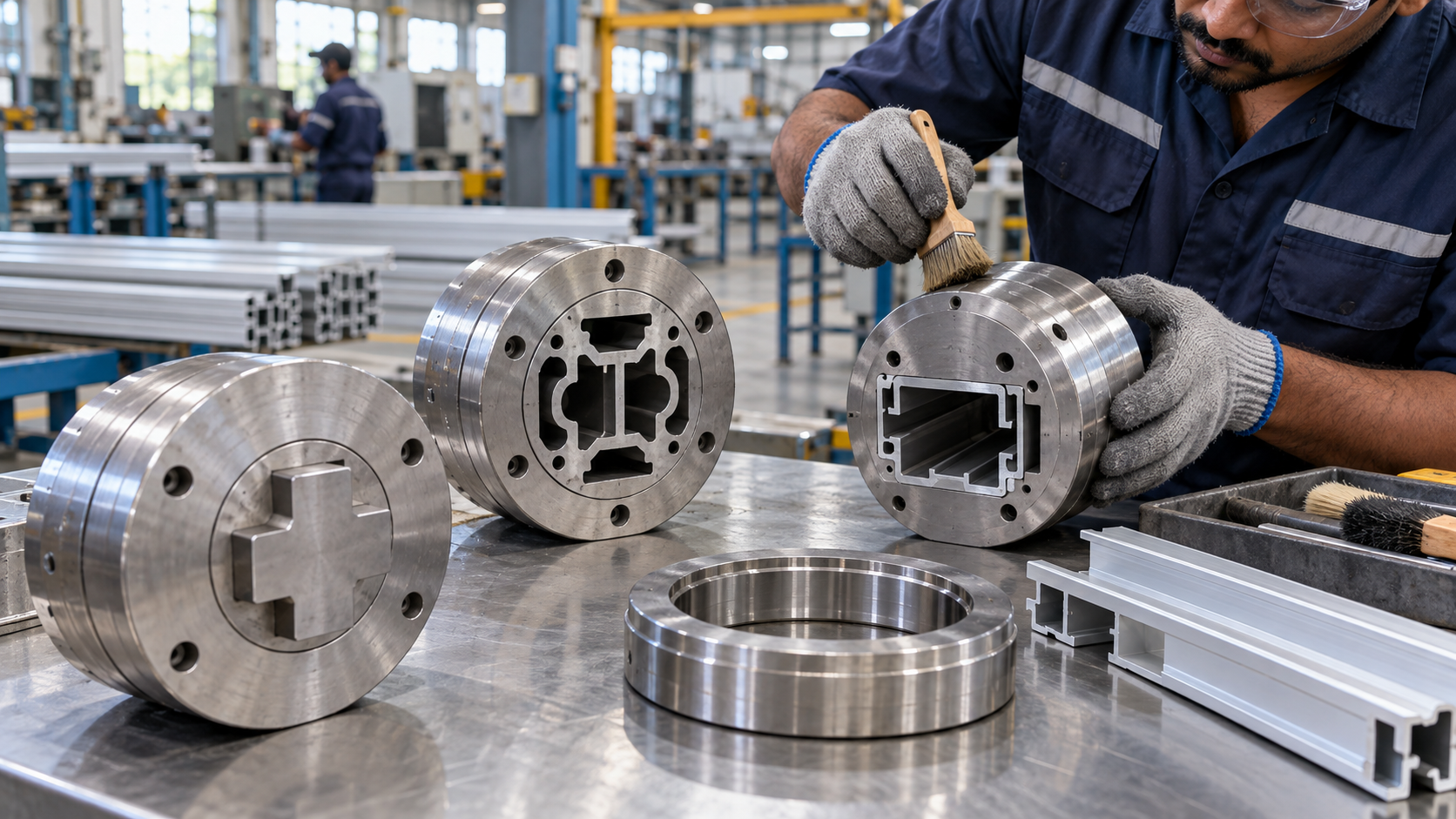
When you look at a finished aluminium profile, the die behind its shape may not be the first thing you think about. Yet it plays a major role in determining how accurately and consistently that profile is produced. This is why die maintenance in aluminium extrusion is an essential part of reliable manufacturing. Regular inspection, cleaning, correction, and care of extrusion dies can help maintain profile quality while preventing avoidable production problems.
For manufacturers and buyers alike, understanding the different types of aluminium extrusion dies and their maintenance can also help explain how tooling influences dimensional accuracy, surface finish, and production consistency.
Why Are Aluminium Extrusion Dies So Important?
During the aluminium extrusion process, a heated aluminium billet is forced through a specially designed die. The opening in the die determines the cross-sectional shape of the final profile.
Whether producing a simple channel or a complex custom section, aluminium extrusion dies must maintain the required geometry throughout production. Even minor changes in a die can affect how aluminium flows through it and, ultimately, the finished profile.
That makes the condition of the die directly connected to aluminium extrusion quality.
Different Types of Aluminium Extrusion Dies
Not all aluminium extrusion dies are designed in the same way. The type of die used depends largely on the geometry of the profile, particularly whether the required cross-section is solid, hollow or partially enclosed. The main types include:
Solid Dies: Used for profiles without enclosed internal cavities. These dies are commonly used for solid and open cross-sections such as bars, angles and channels.
Hollow Dies: Designed for profiles containing one or more completely enclosed cavities. These dies use internal tooling to create the hollow section and generally require more complex control of aluminium flow.
Semi-Hollow Dies: Used for profiles with partially enclosed spaces rather than completely closed cavities. Their design depends on the geometry and opening of the profile.
Porthole Dies: A type of hollow die in which aluminium flows through separate ports around a mandrel and rejoins before exiting the die. This makes porthole dies suitable for producing a range of hollow aluminium profiles.
Bridge Dies: Another type of hollow die, where supporting bridges hold the mandrel that forms the internal cavity while allowing aluminium to flow around it.
Selecting the appropriate extrusion die design is important because profile geometry, dimensional requirements and production conditions can influence how the aluminium flows through the die and the quality of the finished extrusion.
What Causes Aluminium Extrusion Die Wear?
Extrusion dies are exposed to high temperature, pressure and continuous aluminium flow during production. Over repeated extrusion cycles, these conditions can gradually affect the die.
Common contributors include:
- High extrusion temperatures
- High extrusion pressure
- Repeated production cycles
- Aluminium flow and friction
- Inadequate cleaning
- Improper die handling or storage
- Excessive production runs without inspection
What Happens When Extrusion Dies Wear?
Dies operate under high pressure and temperature, so some extrusion die wear is expected over time. The important part is identifying and addressing it before it begins affecting production.
Poorly maintained dies may contribute to:
- Changes in profile dimensions
- Inconsistent wall thickness
- Poor or uneven surface finish
- Profile distortion
- Increased rejection or rework
- Greater production interruptions
For applications requiring precision aluminium extrusion, these variations can become particularly important. A small dimensional change may affect how the profile fits, connects, or performs in the final assembly.
How Preventive Die Maintenance Supports Quality
Preventive die maintenance focuses on checking and maintaining dies before significant problems develop. Instead of waiting for a die to produce unacceptable profiles, manufacturers can inspect its condition at appropriate intervals and take corrective action when necessary.
Here is how regular extrusion die maintenance contributes to production:
|
Maintenance Area |
Manufacturing Benefit |
|
Regular inspection |
Helps identify wear or damage early |
|
Proper cleaning |
Removes residues that may affect extrusion |
|
Die correction |
Helps maintain profile dimensions |
|
Wear monitoring |
Supports consistent profile production |
|
Planned maintenance |
Helps reduce unexpected production issues |
A structured maintenance approach can also extend extrusion die lifespan, allowing manufacturers to get more consistent performance from their tooling.
Better Die Condition, Better Dimensional Accuracy
In aluminium profile manufacturing, consistency matters just as much as creating the right shape. Buyers expect one production batch to match the required specifications just as closely as the next.
Maintaining dies in good condition supports dimensional accuracy by helping the profile retain its intended cross-section and tolerances. This becomes especially important for custom profiles used in engineering, automotive, architectural, solar, electronics, and industrial applications.
Proper maintenance can also help reduce certain extrusion defects associated with tooling conditions, supporting more stable production and reducing unnecessary material loss.
What Does Aluminium Extrusion Die Maintenance Involve?
Aluminium extrusion die maintenance involves several activities designed to keep the tooling in suitable condition for consistent production. Depending on the die condition and production requirements, these may include:
Die Inspection
Dies are inspected for wear, damage, deformation, cracks and changes in critical areas of the die geometry.
Cleaning
Residual aluminium, oxides and other deposits are removed to prevent them from affecting material flow and surface quality.
Die Correction and Polishing
Where required, controlled correction or polishing can help restore the die's functional geometry and surface condition.
Wear Monitoring
Tracking die performance over repeated production runs can help identify gradual changes before they result in significant profile variations.
Proper Storage and Handling
Cleaning, protecting and storing dies correctly between production runs helps reduce unnecessary damage and contamination.
Why Die Maintenance Matters to Buyers Too
Die maintenance may sound like something only an extrusion manufacturer needs to worry about, but its effects reach the customer as well.
When sourcing custom profiles, consistent tooling practices can contribute to:
- Reliable dimensions across repeat orders
- Better profile-to-profile consistency
- Reduced risk of rejected components
- More predictable assembly
- Consistent surface quality
So, when choosing a custom aluminium extrusion manufacturer, it is worth looking beyond production capacity alone. Process control and quality management are equally important.
How INEX Focuses on Precision and Quality
At INEX, precision and quality are considered throughout the manufacturing process, from design and extrusion to fabrication, finishing and final quality checks. Its PLC-controlled extrusion presses support controlled production, while every batch undergoes in-house testing and continuous monitoring.
As an ISO 9001:2015-certified aluminium extrusion manufacturer in India, INEX combines extrusion capabilities with precision fabrication, CNC machinery and in-house finishing facilities. Its vertically integrated manufacturing approach provides greater control across different stages of production.
For customers, this means working with a manufacturer that focuses on dimensional accuracy, consistency and quality throughout production, not only during final inspection.
Conclusion
Good profiles begin with the right tooling and good process control. Different types of aluminium extrusion dies are used according to profile geometry and production requirements, while effective die maintenance helps manufacturers protect dimensional accuracy, improve consistency, manage die wear, reduce avoidable defects and support longer tooling life.
For businesses looking for reliable custom aluminium profiles, INEX brings together precision manufacturing, quality control, customisation, and integrated production capabilities to deliver solutions designed around real project requirements.
Looking for precision aluminium profiles for your project? Contact INEX to discuss your custom extrusion requirements.
Frequently Asked Questions (FAQ)
1. What is die maintenance in aluminium extrusion?
Die maintenance in aluminium extrusion involves regularly inspecting, cleaning, correcting, and maintaining extrusion dies to support consistent profile dimensions, surface quality, and production performance.
2. Why is aluminium extrusion die maintenance important?
Regular die maintenance helps control wear, maintain dimensional accuracy, reduce production issues, and support consistent aluminium extrusion quality across production batches.
3. How does die wear affect aluminium extrusion quality?
Extrusion die wear can affect profile dimensions, wall thickness, surface finish, and overall consistency. If not addressed in time, it may also lead to higher rejection or rework.
4. What causes extrusion dies to wear over time?
Extrusion dies operate under high temperatures, pressure, and repeated material flow. Over time, these operating conditions can gradually cause wear and affect die performance.
5. How does preventive die maintenance help aluminium production?
Preventive die maintenance helps manufacturers identify wear or damage before it creates significant production problems. It can support consistent output and reduce unexpected interruptions.
6. Can proper maintenance increase extrusion die lifespan?
Yes. Regular inspection, cleaning, wear monitoring, and timely corrective measures can help extend extrusion die lifespan and maintain more consistent performance.
7. Can poor die maintenance cause aluminium extrusion defects?
Tooling conditions can contribute to certain aluminium extrusion defects, including dimensional variations, profile distortion, inconsistent wall thickness, and surface-quality issues.
8. How does die maintenance improve dimensional accuracy?
Maintaining the intended die geometry helps control aluminium flow during extrusion, supporting dimensional accuracy and consistent cross-sections in finished profiles.
9. Why does die maintenance matter when ordering custom aluminium profiles?
Custom profiles may require specific dimensions and tolerances. Proper die maintenance helps manufacturers achieve greater consistency across profiles and repeat production orders.
10. What should buyers consider when choosing an aluminium extrusion manufacturer?
Buyers should consider manufacturing capabilities, process control, quality management, dimensional accuracy, customization capabilities, production consistency, and experience with the required applications.
11. What are the main types of aluminium extrusion dies?
Extrusion dies are generally designed for solid, hollow, or semi-hollow profiles. The die design depends on the profile’s shape, dimensions, and production requirements.
12. What is die correction in aluminium extrusion?
Die correction involves making controlled adjustments to a die when the extruded profile does not meet the required shape, dimensions, or surface quality.
13. How do manufacturers check whether a die needs correction?
They inspect the die and compare the finished profile with its specified dimensions and quality requirements. Production feedback helps the die maintenance team identify where a correction may be needed.
14. Does every aluminium profile require a separate die?
A custom profile usually requires a die designed for its cross-section. Profiles with different shapes or dimensions may need different tooling, even when they serve similar applications.
15. Why is die inspection important before repeat orders?
For repeat orders, inspection helps confirm that the die remains suitable for producing the required profile. This supports consistency with previously approved dimensions and tolerances.
16. When should an extrusion die be replaced rather than repaired?
Replacement may be necessary when wear or damage prevents the die from reliably producing a profile within the required specifications. The decision depends on the die’s condition, the feasibility of correction, and the quality of the profiles it produces.
