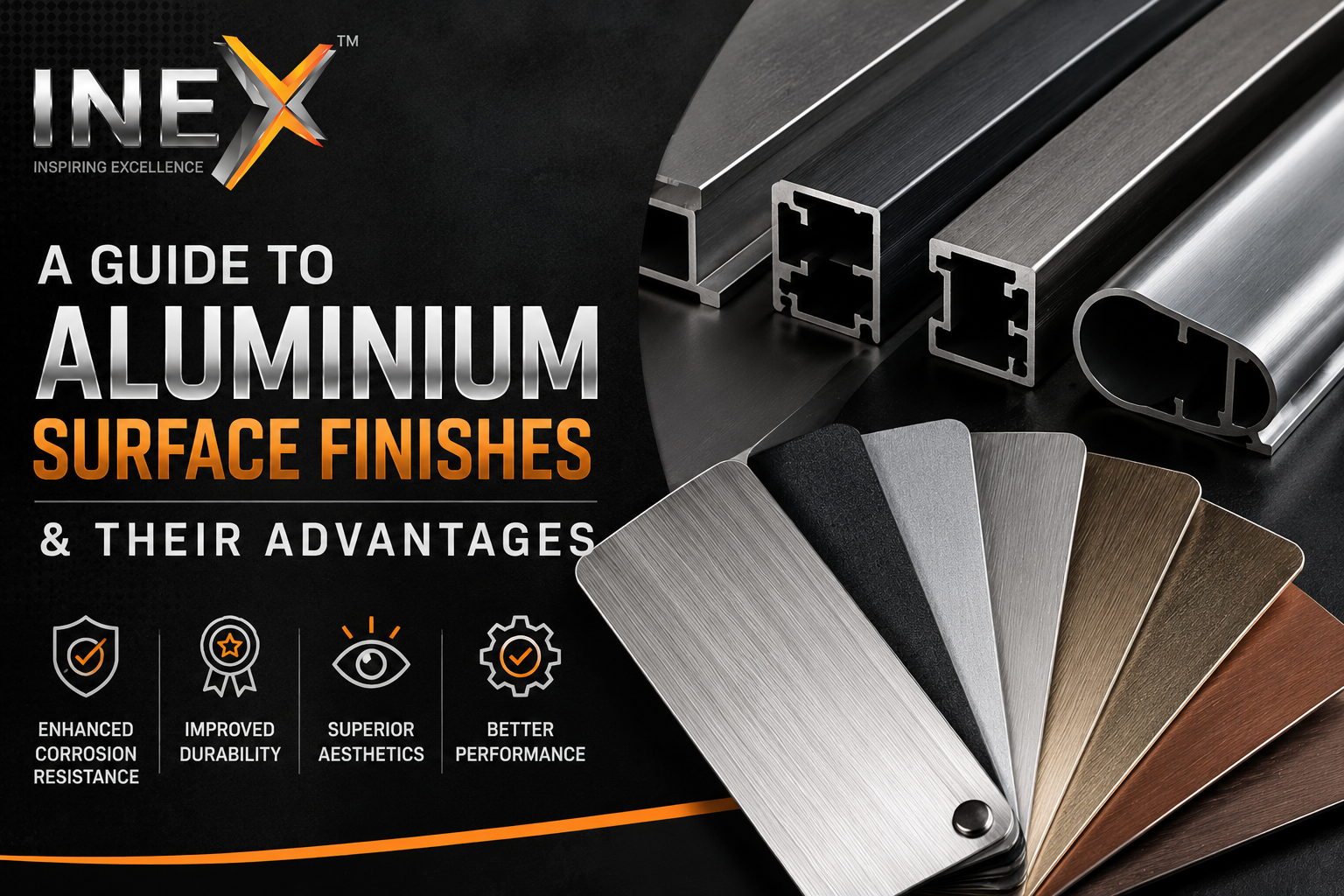
Whether you're designing a commercial building, manufacturing industrial equipment, or fabricating custom aluminium products, choosing the right types of aluminium surface finishes is just as important as selecting the right aluminium alloy. It not only enhances the appearance but also determines its durability, corrosion resistance, maintenance requirements, and overall lifespan.
Modern aluminium surface finishes are designed to do much more than improve aesthetics. They provide aluminium surface protection, improve weather resistance, increase product life, and help aluminium perform reliably in demanding industrial and architectural environments.
In this guide, we'll explore the most widely used types of surface finishes, their advantages, and why choosing an experienced aluminium extrusion manufacturer like INEX makes all the difference.
Why Aluminium Surface Finishing Is Important
Although aluminium naturally forms a thin oxide layer, this alone isn't sufficient for many industrial or outdoor applications. Professional aluminium extrusion finishing provides an additional layer of protection while improving the product's visual appeal.
The right finish helps to:
- Improve corrosion resistance
- Protect against scratches and wear
- Enhance weather and UV resistance
- Increase product lifespan
- Reduce maintenance costs
- Deliver an attractive, premium appearance
Simply put, investing in the right finish ensures your aluminium profiles continue performing efficiently for years.
Common Types of Aluminium Surface Finishes
Mill Finish Aluminium
Mill finish aluminium is the natural finish obtained directly after the extrusion process without additional treatment.
Advantages
- Cost-effective
- Suitable for further fabrication
- Ideal for internal structural components
Best Applications
- Industrial fabrication
- Machine components
- Profiles that will receive secondary finishing
Anodised Aluminium Finish
An anodized aluminium finish is created through an electrochemical process that strengthens the natural oxide layer of aluminium.
Advantages
- Excellent corrosion resistance
- Superior scratch resistance
- Long-lasting colour stability
- Increased surface hardness
- Low maintenance
This is one of the most popular corrosion resistant aluminium finishing methods for architectural and outdoor applications.
Powder Coated Aluminium
Powder-coated aluminium involves applying a dry powder coating that's baked to form a highly durable protective layer.
Advantages
- Extensive colour options
- Excellent weather resistance
- UV protection
- Attractive finish
- Long service life
The benefits of powder-coated aluminium profiles make this finish ideal for windows, doors, curtain walls, railings, and commercial buildings.
Brushed Aluminium Finish
A brushed aluminium finish creates a fine satin texture through mechanical brushing.
Advantages
- Elegant appearance
- Hides fingerprints and minor scratches
- Modern aesthetic
Best Applications
- Furniture
- Consumer electronics
- Interior décor
- Premium architectural projects
Polished Aluminium Finish
A polished aluminium finish produces a smooth, reflective, mirror-like surface.
Advantages
- Premium appearance
- High reflectivity
- Decorative appeal
Ideal for luxury interiors, display systems, automotive components, and decorative installations.
PVDF Coating for Aluminium
PVDF coating for aluminium is widely recognised as one of the most durable exterior finishing methods.
Advantages
- Outstanding UV resistance
- Exceptional weather protection
- Chemical resistance
- Long-lasting colour retention
It is commonly used for high-rise buildings, curtain walls, facades, and commercial infrastructure.
Electroplated Aluminium
Electroplated aluminium involves depositing a thin metallic coating over aluminium to improve appearance and performance.
Advantages
- Improved wear resistance
- Enhanced decorative finish
- Better electrical conductivity for specialised applications
Commonly used in automotive, electronics, and industrial components.
Bead Blasted Aluminium Finish
Bead blasted aluminium finish uses fine abrasive media to create a uniform matte texture.
Advantages
- Smooth, premium appearance
- Conceals minor surface imperfections
- Improves consistency across components
Widely used in consumer products, electronics, and precision-engineered parts.
Wood Grain Aluminium Finish
A wood grain finish replicates the appearance of natural timber while retaining aluminium's strength.
Advantages
- Natural wood aesthetics
- Weather resistance
- Low maintenance
- Long-lasting finish
Perfect for windows, doors, pergolas, and architectural applications.
Nano Coating for Aluminium
Nano coating is an advanced surface treatment that forms an ultra-thin protective layer over aluminium. Rather than replacing traditional finishes, it is often applied over anodized or powder-coated surfaces to enhance durability and reduce maintenance.
Advantages
- Water and dust repellence
- Easy-to-clean surface
- Fingerprint and stain resistance
- Enhanced UV and weather protection
- Longer-lasting appearance
Best Applications
- Premium architectural projects
- Commercial buildings
- Solar panel frames
- High-end aluminium products
Powder Coating vs Anodising Aluminium
One of the most common questions buyers ask is: Powder coating vs anodising aluminium which is better?
Choose Anodised Aluminium Finish if your priority is:
- Maximum corrosion resistance
- Hard surface protection
- Metallic appearance
Choose Powder Coated Aluminium if you need:
- Decorative colours
- Superior design flexibility
- Excellent weather resistance
Both are among the best aluminium surface finishes, and the ideal choice depends on your project's environment and performance requirements.
How to Choose the Right Aluminium Surface Finish
Selecting the right aluminium profile surface finish depends on:
- Indoor or outdoor use
- Environmental exposure
- Durability requirements
- Aesthetic preferences
- Maintenance expectations
- Budget
For industrial projects, corrosion resistance is often the top priority, while architectural applications typically require a balance of durability and visual appeal.
Why INEX is a Trusted Name for Aluminium Surface Finishing
At INEX, surface finishing isn't treated as the final step, it's an integral part of our manufacturing process. From billet selection and die development to extrusion and finishing, every stage is carefully monitored to ensure superior quality and consistency.
Why industries trust INEX:
- In-house aluminium extrusion, die-making, and finishing capabilities
- Multiple aluminium coating methods for industrial and architectural applications
- Rigorous testing for coating thickness, adhesion, and corrosion resistance
- High-performance extruded aluminium profiles built for demanding environments
- Reliable production capacity for infrastructure, construction, renewable energy, and custom aluminium fabrication projects
- Consistent quality, timely delivery, and customer-focused engineering support
As one of the trusted and top aluminium extrusion manufacturers in Odisha and a reliable aluminium extrusion company in India, INEX helps customers choose the most suitable finish for every application, delivering aluminium profiles that perform today and continue performing for years to come.
How INEX Supports India's Aluminium Industry
INEX goes beyond manufacturing by helping customers choose the right aluminium surface finishes for better performance, durability, and long-term value.
Why businesses trust INEX:
- Advanced in-house extrusion and finishing capabilities
- Precision-engineered profiles for diverse industries
- Rigorous quality testing for consistent performance
- Customised solutions with reliable delivery
With a focus on innovation and quality, we continue to support industries across India with aluminium solutions built to perform.
Conclusion
Choosing the right type of surface finishes is key to improving the durability, appearance, and long-term performance of aluminium products. From mill finish and anodized aluminium finish to powder coated aluminium and PVDF coatings, each finish offers distinct advantages based on your application and performance needs.
At INEX, we deliver precision-engineered aluminium profiles with premium finishing solutions tailored for industrial and architectural projects.
If you are looking for reliable aluminium extrusion solutions? Contact INEX today and let our experts help you choose the ideal finish for lasting performance and quality.
Frequently Asked Questions (FAQs)
1. What are the different types of aluminium surface finishes?
The most common types of aluminium surface finishes include mill finish, anodized finish, powder coating, brushed finish, polished finish, and PVDF coating. Each finish offers unique benefits depending on the application and environment.
2. Why is aluminium surface finishing important?
Aluminium surface finishing improves corrosion resistance, enhances durability, protects against wear and weathering, and gives aluminium profiles an attractive appearance, making them suitable for both industrial and architectural applications.
3. Which aluminium surface finish lasts the longest?
Anodised aluminium and PVDF-coated aluminium are among the longest-lasting finishes. They offer excellent resistance to corrosion, UV exposure, and harsh environmental conditions, making them ideal for outdoor applications.
4. What is the difference between powder coating and anodising aluminium?
Powder coating adds a coloured protective layer with excellent weather resistance and design flexibility, while anodizing creates a hard oxide layer that improves corrosion resistance and surface hardness while retaining a metallic appearance.
5. Which aluminium surface finish is best for industrial applications?
For industrial applications, anodized finishes and powder-coated aluminium are popular choices due to their durability, corrosion resistance, and ability to withstand demanding operating conditions.
6. How do aluminium surface finishes improve durability?
Surface finishes protect aluminium from corrosion, scratches, moisture, chemicals, and UV exposure. This extends the lifespan of aluminium profiles and reduces long-term maintenance costs.
7. How do I choose the right aluminium surface finish?
The ideal finish depends on factors such as the application, environmental conditions, aesthetic requirements, durability expectations, and budget. Consulting an experienced aluminium extrusion manufacturer can help you select the most suitable option.
8. What industries use finished aluminium profiles?
Finished aluminium profiles are widely used in construction, architecture, renewable energy, automotive, transportation, electronics, furniture, and industrial manufacturing.
9. Why choose INEX for aluminium extrusion and surface finishing?
INEX offers advanced aluminium extrusion, in-house finishing capabilities, rigorous quality control, and customised solutions. Every profile is engineered for durability, precision, and reliable performance across industrial and architectural applications.
10. How can I get a quote for aluminium extrusion products from INEX?
You can contact the INEX team through the website, email, or phone with your project specifications. Their experts will recommend the most suitable surface finish and provide a customised quotation based on your requirements.